It may seem to Nick Clegg the correct thing to do after Gordon Brown has apologised for his “bigot” remark is to be the proper gentleman and suggest we put it behind us. But Brown’s unguarded remark reveals how much contempt he has for ordinary people and reminds us why we want and need change. It is the breathtaking arrogance of so many of our masters in Parliament, exemplified by the expenses scandal, that has us so riled. This government has signed-over our rights to Europe and denied us the right to have a referendum, they won’t even have a debate on whether to have a referendum. They sign into Law new legislation by Order in Council, evading even the minimal scrutiny this lame-duck Parliament gives to anything these days. They even told us flat-out lies in order to get support for a war that all the evidence suggests was illegal. No, Mr Clegg, you are wrong. That gaffe goes to the very heart of the problem; we want to be listened to, we want our opinions heard, we are not bigots. If you don’t know that, then you don’t really understand us.
Virus Warning
A new virus has been discovered that has been described by the Daily Telegraph as the most dangerous ever to hit Britain. Innocent users are being duped into marking an “X” in a box on a piece of paper that will result in catastrophic consequences. If you receive a manifesto with a picture of a red rose on it, destroy it immediately, if you do not it will infect the election process and may result in the following:
* More rights being given away to Europe without a referendum
* Higher taxes for low income households, lower taxes for the mega-rich
* Continued double-dip recession and increased taxes on jobs
* Continued low spending on our armed forces and neglect of the wounded
* Continued lack of border control and increased uncontrolled immigration
* Continued assaults on anything representing British culture and values
Do not put a cross in the box next to “Labour” on your ballot paper.
Virus removal procedure:
If you become accidentally infected by this virus, there is only one thing you can do: emigrate
OMG, I am so honoured!
This has just landed in my in-box, and frankly I am overwhelmed. Thank you, thank you, thank you to everyone who nominated me, I feel so humbled to receive your recognition. My life will not be the same after this. Who is the Presidential Who’s Who anyway?
Dear Mark,
You were recently chosen as a potential candidate to represent your professional community in the 2010 Edition of Presidential Who’s Who.
We are please to inform you that your candidacy was formally approved February 28th, 2010. Congratulations.
The Publishing Committee selected you as a potential candidate based not only upon your current standing, but focusing as well on criteria from executive and professional directories, associations, and trade journals. Given your background, the Director believes your profile makes a fitting addition to our publication.
There is no fee nor obligation to be listed. As we are working off of secondary sources, we must receive verification from you that your profile is accurate. After receiving verification, we will validate your registry listing within seven business days.
Once finalized, your listing will share prominent registry space with thousands of fellow accomplished individuals across the globe, each representing accomplishment within their own geographical area.
To verify your profile and accept the candidacy, please visit here. Our registration deadline for this year’s candidates is March 31th, 2010. To ensure you are included, we must receive your verification on or before this date. On behalf of our Committee I salute your achievement and welcome you to our association.
Sincerely,
MarkAnthony McGuiness
Chief Operations Officer
Presidential Who’s Who
134 Rockaway Ave
Valley Stream, NY 11590, USA
The Death of the Photographer
I was rather taken aback when I went to the Telegraph web site recently to read up on a topic I was interested in. I found three or four reports on what I was looking for, but they were all videos. Aside from one photo in a paragraph that linked into these stories, there were no other photos, and aside from the introductory text on the same paragraph, there was no other text. I would have expected this on the BBC web site, after all they are a television broadcaster, but the Telegraph exists in the world of the printed word.
Writing imposes certain disciplines, it trains the mind to think and construct arguments, to make points, to reason. Writing also works because it has to be read, and you have to think to read. With words, you can re-read a sentence and ponder any deeper meaning. Writing can be Googled, linked and quoted. The written word, therefore, helps us to tease out knowledge and improve our understanding because it makes the writer think about what he’s writing, and gives the reader time to think and digest that meaning.
Video is an entirely different medium. That’s not to say that a well-written and well delivered piece to camera cannot have any impact, on the contrary, it can have massive impact which can be multiplied when transcribed and made available to a wider audience. But it’s impossible for a commentator to alter a single word or phrase without having to re-record the whole segment, it’s tedious for the viewer to rewind and play a clip repeatedly to review a comment, and all too easy to “space out” and miss a crucial point.
But my greatest disappointment is for what this video-only trend means to the art of photography. It is of course a tired cliche to say that a picture is worth a thousand words, but I really believe that, even in this photoshopped era. However, it does not follow that video at 30 frames per second is worth thirty thousand words per second. A short video clip may indeed be worth less than an excellent photograph because in my view, the skilled photographer can capture a moment in time which we can then study at length.
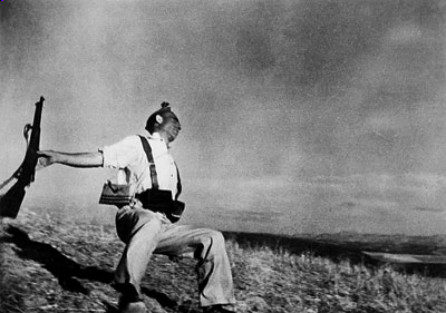
News media are struggling to maintain full complements of journalists as it is, but if they also need more cameramen to record video then traditional stills photography will be sacrificed. I don’t think a frame-grab from video is the same thing. So I see fewer photographers out there in future and the diminishing of a remarkable medium for documenting social and political history. Would Robert Capa’s “Death of a Loyalist Soldier” have resonated down the ages if it had been a clip on YouTube? I don’t think so.
When all you have is a hammer, every problem looks like a nail
Problem: Smoking is bad for your health.
Solution: Put a tax on it.
Problem: We need to increase availability of broadband.
Solution: Put a tax on it.
“Government plans for a 50p-a-month tax on households to fund super-fast broadband across the country have been criticised by an influential group of MPs,” says a report on Sky News, and quite right too.
The instinct of this government is to tax, however clumsy or counter-productive it might be. If the government wants to encourage virtuous activity, they should give businesses an incentive to do it.
Follow-Up
I have to edit this and add the latest piece of insanity from this government. With a recession still ongoing and jobs, you would think, being a top priority, this government wants to increase the tax on jobs that is National Insurance. Not only will workers take home less pay, but employers will pay more too. So:
Problem: Low employment
Solution: Increase the tax on jobs
Going Gordo on a Scale of One to Ten
As my contribution to the debate about the Prime Minister’s temper, I would like to offer this scale to assist those who may be risking life and limb in approaching him, so they may be aware of the level of danger they face, or warn others accordingly.
Force One: Is calm and placid
Force Two: Becomes agitated
Force Three: Throws a dark look
Force Four: Throws a small item of stationery
Force Five: Throws an insult
Force Six: Throws a mobile phone
Force Seven: Throws a tantrum
Force Eight: Throws a large item of office equipment
Force Nine: Throws a punch
Force Ten: Kicks the furniture over
Hat tip to Iain Dale for the details.
The Reader’s Digest, fondly remembered
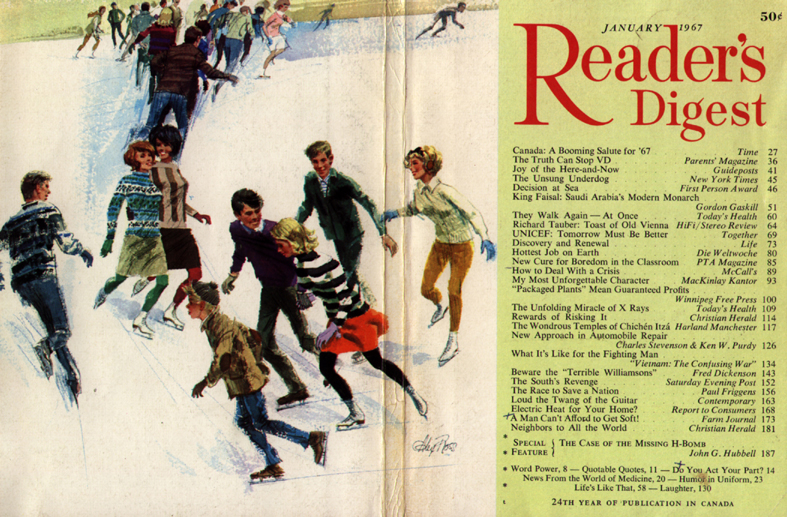
This is really sad news. Reader’s Digest in the UK has gone into administration. I remember as a child in Singapore many years ago that, despite being surrounded by learning at an outstanding boarding school, in particular spending hours in a well stocked library, Reader’s Digest was my most valued source of knowledge and the real agent for the broadening of my outlook on life.
The magazine had a wide and eclectic range of essays, all well written in an accessible, informative style. I enjoyed the mix of jokes and real life anecdotes, even the adverts seemed to impart knowledge. But I especially treasured William Funk’s word quiz in particular. So valuable was this magazine to me that I would use some of my modest allowance to buy a copy and devour it, every page, cover to cover.
It was in Reader’s Digest that I read about the life of President Kennedy; of the dangers of smoking (even then!): and of real life struggles against adversity by many extraordinary yet ordinary people. In some respects, Reader’s Digest was a forerunner of Dorling Kindersley’s books in the way they explained and illustrated their stories. I didn’t get the same buzz again until many years later when I bought a set of Encyclopedia Britannica.
I tried a subscription to it here in the UK a couple of years ago, but I think really our 24 hour news culture and the Internet had killed it off. Practically everything I read in it I had already read about somewhere else. We have an incredibly wide source of knowledge and information today. My main sources are the Viigo rss feed on my BlackBerry, and through it Huffington Post, the New York Times, the Daily Telegraph, Slashdot and Techcrunch. I also use Google and Wikipedia a lot, and for a good handle on what passes for the current conversation, Facebook and Twitter.
Given all that, it’s hard to see how there could be a role for Reader’s Digest in any format. But I still have a great sense of loss.
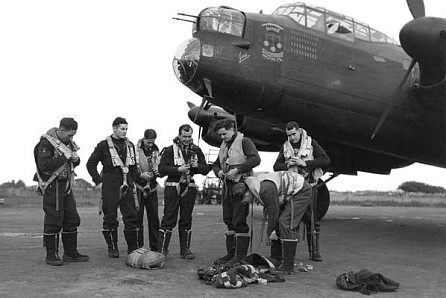
Remembering the brave boys of Bomber Command
War is an ugly, horrible business as anyone who has been involved will tell you, whether combatant or civilian. And while time heals all but the deepest wounds and former adversaries can meet again in peace, that’s not to say we should forget those wounds because I can’t think of a single war fought between two sides who were both the “good guys”. Inevitably, wars are between good and evil and in the interests of celebrating the triumph of good over evil, the good guys should be remembered and they deserve to have their sacrifices honoured.
That doesn’t always happen, and it hasn’t happened yet in the case of 55,000 courageous young men who made the ultimate sacrifice and gave their lives for our freedom. They served in the RAF’s Bomber Command and had a worse chance of survival than a world war one infantry officer. 55,000 killed out of 125,000 aircrew is a devastating loss ratio, yet those who survived one raid went back out on the next one. They received no Campaign Medal for their extraordinary bravery, and they still do not have an official memorial. Dresden is often cited as the reason.
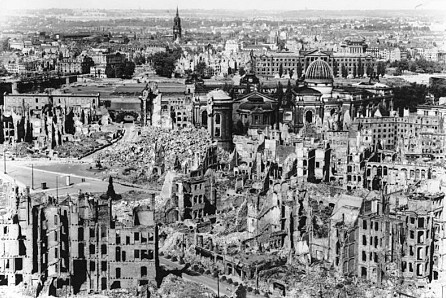
This weekend marks the 65th anniversary of the bombing of Dresden. Over the course of two nights, 1300 heavy bombers dropped 3900 tons of bombs resulting in a firestorm that claimed up to 25,000 mostly civilian lives, and it remains one of the most controversial acts of world war two. I lament any death, but what is special about Dresden? Other cities had a worse pounding, don’t their dead count for anything? Or is it okay if civilians are only killed in ones and twos? Is it because they died in a firestorm and some other method of killing them would have been okay?
We should remember the loss of all civilians killed in the war, and not single out the unfortunate residents of Dresden and forget the rest. So why do we do that? Quite simply, Dresden remains controversial because of the enduring effect of Nazi propaganda during the war, and Soviet propaganda after it. The Nazis and the Soviets both wanted to demonise us. Würzburg was bombed a month later and suffered more devastation, even though far fewer bombers were involved in one brief air raid. Why do we not remember those poor victims the same way? Is it because “only” 5,000 residents were killed? No, it’s not about the people, Dresden is a touchstone for pacifists while Würzburg didn’t have the benefit of Soviet propaganda.
The propaganda machine continues to crank away, only with different hands working the handle. War is an ugly, horrible business; there is no “nice” way to kill people. But sometimes it is necessary and all that had to happen to prevent Dresden was that Germany had to stop fighting. Yet even children were put into uniform and armed and sent to fight the advancing allies. Is there a practical pacifist response to a ruthless and desperate totalitarian system? The war against the Nazis was necessary, and pacifism was tried first, sincerely and earnestly.
We didn’t choose to go to war lightly and frivolously. We were still weary after the first world war, “the war to end all wars.” But we were confronted with a ruthless, aggressive Germany the Nazis had motivated ready to fight a total war. That included purging Germany of all Jews, Gypsies and the mentally and physically disabled. The good burghers of Dresden were as thorough as any other town or city in sending all their Jews and others to the concentration camps.
Here is the eyewitness account of a Jewish slave worker:
Roman Halter, now 82, was working as munitions worker in Dresden at the time of the attack. A Polish Jew, he had survived the Lodz Ghetto and selections at the death camp of Auschwitz-Birkenau.
He says, “There were cartwheels of fire chasing oxygen and we had to throw ourselves down on the tarmac. The tarmac was already hot. And as we went through people were jumping from buildings.
“People were jumping around with flame. It was horrendous this vision. We had more sympathy for these people than the SS who only cared about guarding us.
“But we felt really that they started the war. We knew that England was bombed, that Coventry was bombed and they deserved whatever they’re getting.”
After the war, Mr Halter came to London and received schooling from former Bomber Command pilots. Inspired by the beauty of Dresden, he became an architect. He says, “Fifty five thousand of them were killed. Everyone of them should have been honoured because they did their duty.
“They didn’t protest; they felt that if Hitler wins, Europe and the world will be thrown into a darkness for a thousand years. And if it had not been for Churchill and the RAF boys we would not have won.”
The contribution of Bomber Command to the war effort was fully understood by the Nazis too. Albert Speer, minister of armaments wrote this after the war:
“The real importance of the air war consisted in the fact that it opened a second front long before the invasion in Europe … Defence against air attacks required the production of thousands of anti-aircraft guns, the stockpiling of tremendous quantities of ammunition all over the country, and holding in readiness hundreds of thousands of soldiers, who in addition had to stay in position by their guns, often totally inactive, for months at a time … No one has yet seen that this was the greatest lost battle on the German side.”
Roman Halter and Albert Speer are both right. And Bomber Command should have its memorial, for without their sacrifice the Nazis would have given us a thousand more Dresdens.
The Robin Hood Tax
Everyone knows the Sheriff of Nottingham is the bad guy. But he’s not just any old bad guy, he’s cunning with it too. He’s conceived of this great new wheeze to extract yet more taxes from us, and he’s got everyone squealing, “Tax me! Tax me!” by the simple expedient of calling it the Robin Hood Tax and pretending it applies to someone else. All across the land, people are casting their vote on a pretty web site calling for this new tax to be introduced. At a stroke, it is claimed, it will combat poverty, tackle global warming and guarantee another season of “Big Brother”. Sheer genius.
Robin Hood’s not best pleased about his name being hijacked in this way and he’s got a few questions he’d like to see answered. I’ll do my best to oblige.
Who is going to pay this tax? Us, the poor peasantry. It is claimed this is a tax on cash-rich irresponsible bankers, the ones we all hate anyway, so this is made out to be a particularly delicious tax. Except, the tax is on transactions of our money; when we pay a bill, or use a credit card abroad, or our pension fund makes an investment, a small tax will be added to the transaction charges. But it is not a small amount, it adds up to billions. £250 billion a year, the web site claims. How else could it achieve any of the stated aims unless it was a substantial amount of money? Does anyone serious believe that tax will not be passed on to us?
Who is going to collect it? The Sheriff of Nottingham. You won’t see his face while the money is being taken from you, but it will all end up in his coffers nonetheless.
Who is going to spend the money? The Sheriff of Nottingham. Think about this for a moment. What is the track record of any government in tackling poverty? Or global warming? Or any of the lofty objectives the Robin Hood Tax proponents put forward? If government had a good track record in any of these areas they wouldn’t be problems in the first place. Giving them more money will lead directly to more inefficiency and waste. Little will end up being applied to the purposes for which it is being collected.
Who will decide what the money is to be spent on? The Sheriff of Nottingham. It will be he who allocates funds according to his own political objectives, as they change with time, and as he sees the need to boost his own popularity.
Who thinks any of it will end up being used for the reasons claimed? Only those poor deluded peasants who are acting as his cheer leaders. And Gordon Brown.
Do you know the funniest aspect of all of this?
Every penny of the Tax will be passed on to us, of course, but because the banks will certainly add their own charges on top:-
– The banks will actually make money out of this.
More bonuses for the bankers!
History repeats itself in the Gulf of Aden
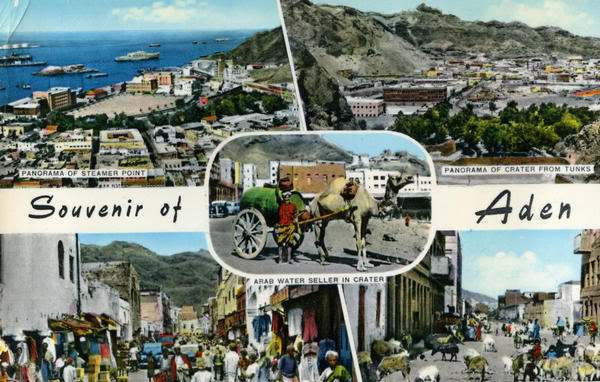
I lived in Aden as a child in the 1960s. I have very fond memories of the place and a clear understanding of how and why we, the Brits, came to be there, and how and why we left. History is full of little ironies, and Aden highlights several.
The first irony is why we were in Aden in the first place. One of the main reasons we went there over 170 years ago, was to combat piracy from Somalia and from along the southern tip of Arabia. It was seriously disrupting global shipping trade passing up the east coast of Africa and across to India. As most of that trade was ours, it was our job to deal with it. We dealt with it by established a naval base at Aden from which to patrol the Gulf of Aden and suppress piracy from Somalia, and by afterwards signing peace treaties with the various sheiks and sultans along the coast. They agreed not to allow piracy from their territories, and we agreed not to invade them. They became known collectively as the Trucial States. It’s a sign of the times that it now falls to the American and Chinese navies, amongst many others, to deal with modern-day Somali piracy.
The second irony is that having once kicked us out, Yemen has applied to join the Commonwealth. Aden in particular wants to break away from Yemen, which it became part of after independence, and has a specific goal of joining the Commonwealth. Yemen as a whole has already applied for membership so it’s not a contentious issue there. Similarly, Somaliland, a British Protectorate until 1960, wants to break away from Somalia, which it became part of after independence, and it too wants to join the Commonwealth. As much as I am a fan of the Commonwealth, I don’t see it as a “magic bullet” solution for failing states. Being a member of the Commonwealth hasn’t ensured that Pakistan, for example, has been able to deal with its own troubles in the North West Provinces. If anything, it has been a conduit that has eased the spread of al Qaeda to the UK, a route they have already started using from Yemen.
Third, the reason Yemenis wanted us out was to assert Arab nationalism, encouraged by Gamal Abdel Nasser who was in turn supported by the Soviet Union with money, weapons and ideology. Neither of them are around any more, but there is a more virulent and dangerous threat now in the form of al Qaeda, who have established a large base of operations in Yemen and thrust Aden back into the news headlines. Bin Laden has a more radical and dangerous agenda than Nasser ever had and, since the Cold War has ended and we have dropped our guard, he doesn’t need the resources of a superpower to back him up. Our own resources, such as the Internet and ease of travel, serve him well enough.
Fourth, the circumstances of our withdrawal from Aden have been, and may be, repeated in Iraq and Afghanistan. We were fighting a rear-guard action against two rival factions vying with each other for domination after we were gone – they had to be seen to be kicking us out. As well as fighting amongst themselves, they continued attacks on British troops even after we had begun to pull out. Bringing the warring Sunni and Shiite factions together has been the biggest challenge for the post-Saddam regime in Iraq. Afghanistan may be a different story unless the warlords can combine to challenge the Taliban.
Fifth, we had the support of Adenis loyal to the local sultans and they suffered vicious retribution afterwards. That pattern may well be repeated in Afghanistan, making anyone – police, army, civilian workers – associated with Hamid Karzai or the UN or Nato likely targets for the Taliban. In Aden, they remained loyal to their sultans and on our side until the end, will that be the case in Afghanistan?
Sixth, while we allowed the sultans to run their own areas outside the port of Aden itself, they were corrupt, autocratic and incompetent. It was as much to get rid of them that the insurgents, as they would now be called, were fighting. That is certainly true in Afghanistan today.
Seventh, the other reason we were in Aden was to establish it as coaling station to service the Royal Navy and our vast merchant fleet. In the post World War Two trade boom, Aden became the second busiest shipping port in the world and in 1958 only New York had more ships per day. But coincident with us pulling out Nasser closed the Suez Canal in 1967 following the Six Day war with Israel, and at a stroke wiped out Aden’s economy. It remained closed until 1975 and pushed South Yemen, as it had become, even further into the hands of the extremists. Afghan villagers have one cash crop – opium. We can’t just wipe that out, we need to ensure they have a viable alternative economy or the effect will be the same, to force them to support their own extremists, the Taliban.
We should try to learn from our experiences, positive and negative, in Aden (1960s), Iraq (1920/30s) and Afghanistan (1840s, 1870s, and again in 1919), as well as in other parts of the world where we have had to deal with insurgencies. Malaya (The Emergency), Kenya (the Mau Mau), and Palestine (Irgun, the Stern Gang) are just three more recent examples of many. We’ve got it right in some places, and dreadfully wrong in others.
History repeats itself because the people and the issues are always the same.